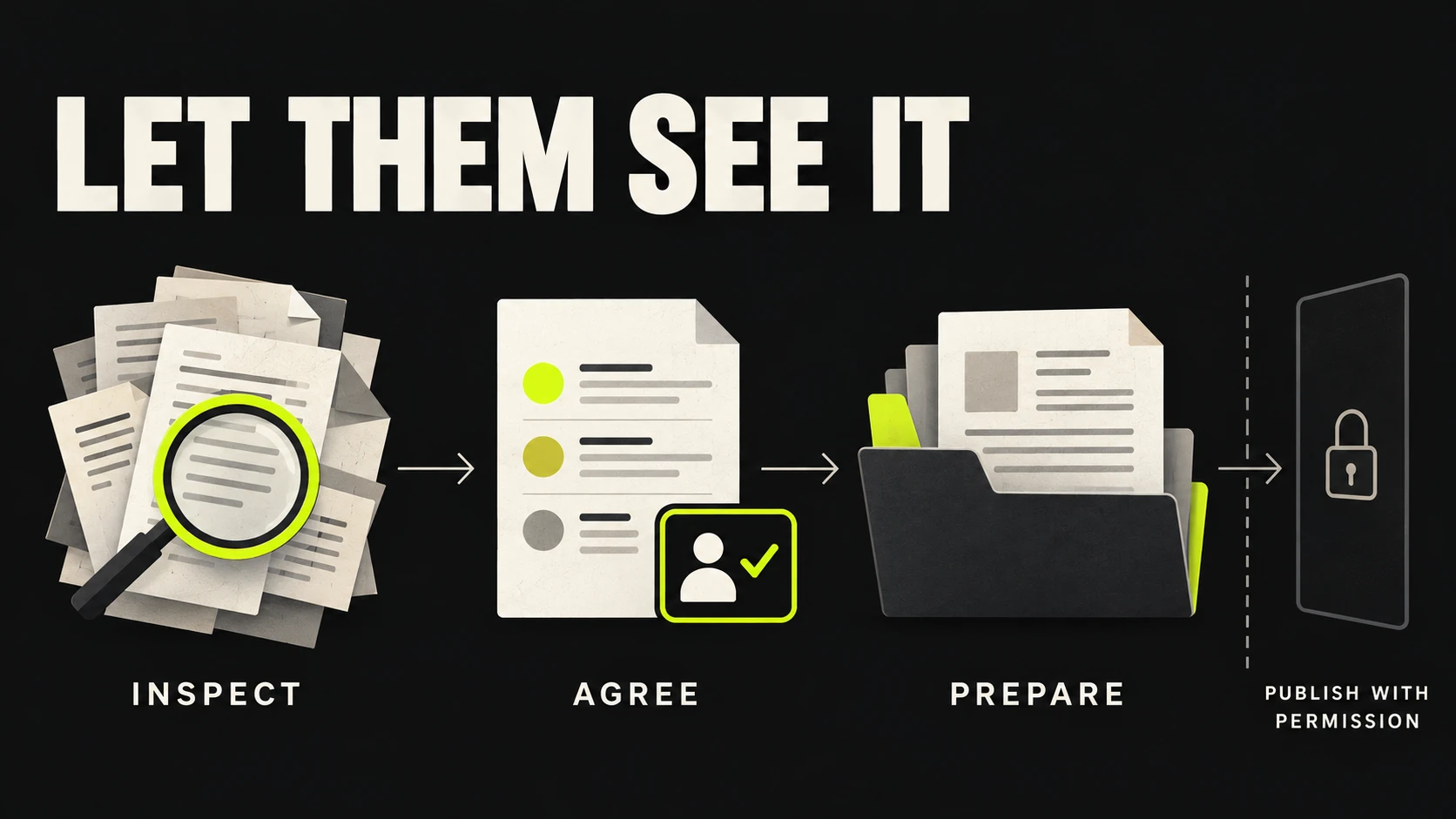
Help people understand, run and contribute to your project. Let Them See It inspects the repository, proposes concrete improvements, and implements the changes you approve.
Evaluate first. Reuse explicit approval. Publish only when authorized.
Concrete examples
From “it works here” to “here’s how to use it.”
Illustrative situations and proposed improvements, not measured results or executed case studies.
A quickstart others can follow
Before “Run the app.” No prerequisites, configuration or working command.
After approval Document the actual prerequisites and commands. Check the quickstart in a fresh disposable clone where feasible; report anything untested.
A repository people can navigate
Before Source, cached output and internal notes share the root. Nobody knows which files matter.
After approval Organize around real build and packaging paths, trace affected callers and verify the shipped contents. Preserve unrelated work.
Documentation across languages
Before The English README has the new install command; translated guides still show the old one.
After approval Agree on languages and paths, align commands, links and coverage, and disclose translations without fluent review.
An honest publication decision
Before A deleted file contains a possible credential. The current tree looks clean.
Expected boundary Flag historical exposure without revealing the value. Block publication on unresolved sensitive findings; recommend revocation or rotation.
The workflow
Evidence before edits.
01 / INSPECT
Read the actual project
Trace installation and usage. Evaluate documentation, structure, sensitive content, licensing and useful checks without editing.
02 / AGREE
Choose a concrete scope
Review a prioritized plan with file evidence and acceptance checks. Existing explicit authorization remains valid.
03 / PREPARE
Implement and verify
Apply the agreed changes. Report verified checks, limitations, open decisions and publication status separately.
Preparation is not permission to publish. Pushes, releases and external posts require authorization.
Install & use
A skill. No app to run.
You need Git and an agent that supports SKILL.md skills. For the default Codex setup, clone into an unused skill directory:
Use your configured skill location if it differs. Start a new agent session if the skill is not yet listed, then ask:
Use $let-them-see-it to evaluate this repository for public release.
Show me the proposed changes before editing anything.
The skill itself requires no runtime packages or API keys. GitHub access and project tools are needed only for actions that use them.
Know the limits
Preparation, with receipts.
This is an instruction-based workflow, not an automated security certification. Scanner availability and agent behavior vary. A passing schema or link check does not prove safe content or correct behavior.
License and asset-rights uncertainties need a maintainer decision. The eight existing README translations are AI-produced and have not received independent fluent review. The skill promises no stars, virality or GitHub Trending placement.